SEO, AEO and GEO: Key Differences and How to Improve Your Business Visibility on Google and AI Platforms
SEO remains essential, but search engines and AI assistants are changing how people find information. Discover the differences between SEO, AEO and GEO, how they work together and what your business should prioritise to improve its online visibility.
By Serginho Cerezo 8 min read
In this article
- What Is SEO and Why Does It Still Matter?
- What Is AEO and How Does Answer Engine Optimisation Work?
- What Is GEO and How Does It Relate to Generative AI?
- SEO, AEO and GEO: What Are the Differences?
- Do You Need to Modify Your Website to Appear in AI-Generated Answers?
- How to Measure Visibility in Search Engines and AI Assistants
- What Should an SME Prioritise in Its Digital Strategy?
For years, many businesses have developed their digital presence with one primary objective: appearing among the top Google results when potential customers search for their products or services. This practice, known as SEO, remains a fundamental part of any online visibility strategy.
However, the way people search for information is evolving. Google is incorporating AI-generated answers into its search experience, while tools such as ChatGPT, Perplexity and other AI assistants allow users to ask complex questions and receive explanations without necessarily browsing a traditional list of links.
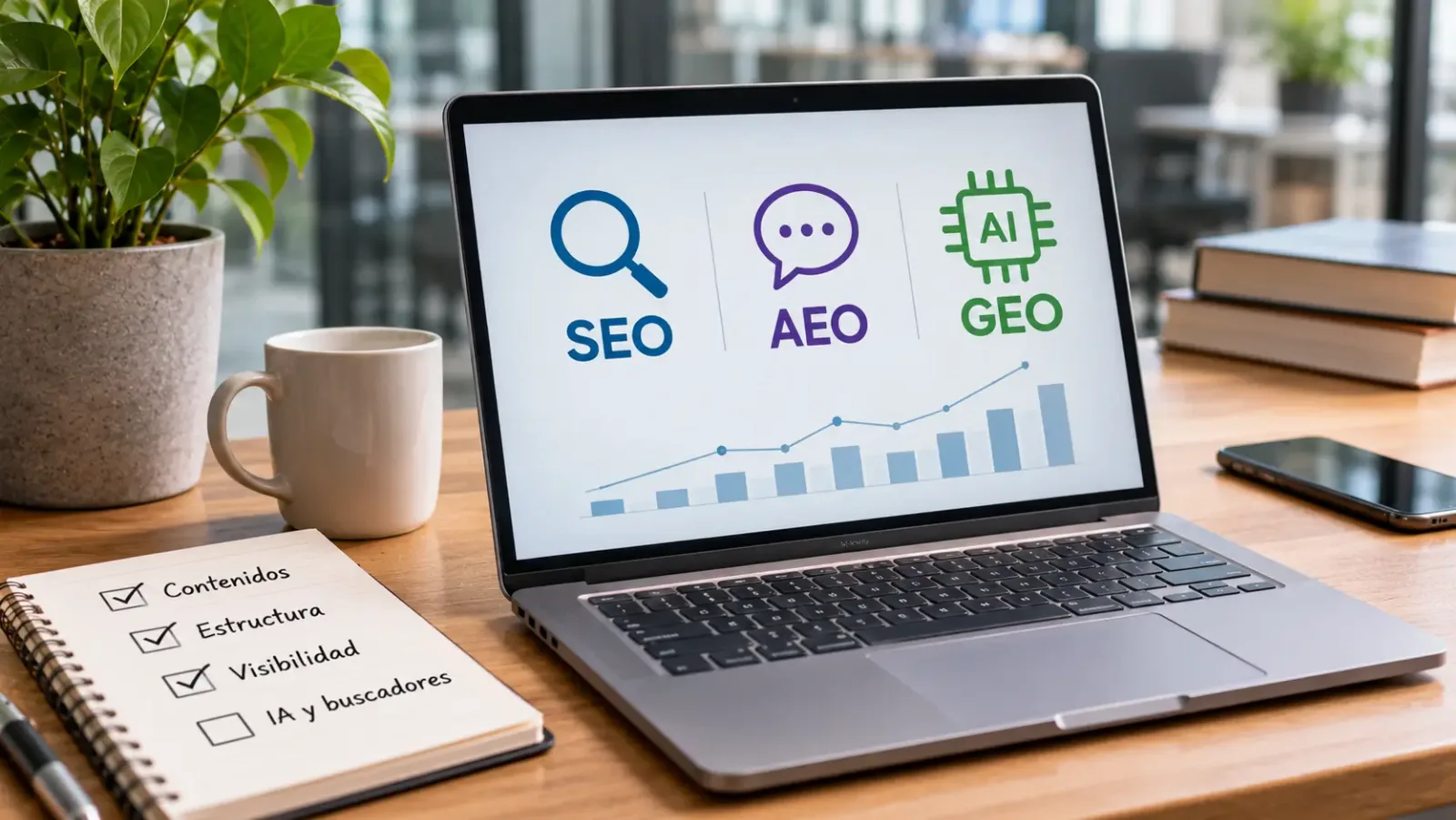
This shift has encouraged the adoption of terms such as AEO (Answer Engine Optimisation) and GEO (Generative Engine Optimisation). Although these concepts are related to digital visibility, they describe different approaches and sometimes overlap.
For small and medium-sized businesses, the priority is not to adopt every new industry acronym. It is to understand how potential customers discover information and what can be done to make the business visible, relevant and trustworthy.
What Is SEO and Why Does It Still Matter?
SEO stands for Search Engine Optimisation. It encompasses practices designed to help search engines discover, understand and display web pages in relevant search results.
SEO covers several areas. Technical optimisation helps ensure that pages can be crawled and indexed correctly. Content optimisation focuses on addressing users' search needs. Website architecture, internal linking and online reputation can also influence visibility.
Consider an IT maintenance company providing services to small businesses in London. Its objective might be to appear when someone searches for "IT maintenance for businesses in London". To support this goal, the company needs a page explaining its services, their characteristics, the types of customers it serves and its geographical coverage.
An SEO strategy may also include articles answering questions commonly asked by potential customers, provided those topics are relevant to the services offered.
Organic search rankings do not guarantee a particular position or immediate results. Performance depends on competition, search demand, content quality and other factors.
Nevertheless, SEO remains an important foundation for helping businesses become discoverable when potential customers have a specific commercial need.
What Is AEO and How Does Answer Engine Optimisation Work?
AEO stands for Answer Engine Optimisation. Its purpose is to make it easier for systems that answer questions to identify, understand and use relevant information.
This concept did not emerge exclusively with generative artificial intelligence. Google's featured snippets, voice searches and other direct-answer formats had already encouraged businesses to create content that provides precise answers to specific questions.
With the expansion of AI assistants, this approach has gained new applications.
For example, someone might ask: "What does a medical clinic need to implement an online appointment booking system?" Useful content should explain the main requirements, availability management, confirmations, data protection and potential integrations.
Information organised through descriptive headings, understandable explanations and answers that directly address individual questions may be easier for both visitors and automated systems to interpret.
However, adding frequently asked questions to every page or using particular content formats does not guarantee that a search engine or AI assistant will select that information when generating an answer.
AEO should be understood as a way to improve content clarity and usefulness, rather than a technique that guarantees inclusion in automated responses.
What Is GEO and How Does It Relate to Generative AI?
GEO stands for Generative Engine Optimisation. The term describes strategies intended to improve the presence of businesses, brands and content in responses produced by generative AI systems.
The main difference from traditional SEO lies in where visibility is being pursued.
In a conventional search, a business aims to have its website appear among the results that users can visit. In a generative system, an answer may combine information from different sources, mention particular companies or provide links and references when the tool supports those features.
Imagine someone asking an AI assistant: "What options are available for developing a hotel's own booking system?" The assistant might explain different technological approaches, describe their advantages and, depending on the tool and available information, mention sources or service providers.
For a company developing these solutions, publishing accurate, consistent and accessible information about its services may help make its activities easier to identify.
Maintaining a coherent digital presence, publishing content that demonstrates industry knowledge and providing verifiable business information are also relevant considerations.
However, generative AI systems use different mechanisms to produce answers. Some search the internet, others rely on information incorporated during model training, and certain tools combine multiple methods.
For this reason, there is no universal formula for ensuring that a brand is mentioned by AI assistants. Responses may vary between tools, queries and different points in time.
SEO, AEO and GEO: What Are the Differences?
Although the three approaches are related, their primary objectives are distinct.
SEO focuses on improving a website's visibility in search engine results. AEO places particular emphasis on making information suitable for answering specific questions. GEO concentrates on the presence of content and brands within responses generated by artificial intelligence systems.
A single web page can contribute to all three objectives. For example, an article explaining how to choose business management software may rank on Google, answer common customer questions and provide information that an AI assistant could use when preparing an explanation.
This does not mean that each approach requires a separate page. Creating three nearly identical articles targeting SEO, AEO and GEO can produce duplication and fragment editorial efforts.
A better approach is to develop comprehensive, well-structured content that addresses genuine needs and can be useful across different search environments.
It is also important to distinguish these concepts from other related disciplines. Local SEO focuses on geographical business visibility, while technical SEO addresses issues such as crawling, indexing and website performance. Terms such as LLMO, or Large Language Model Optimisation, overlap considerably with GEO and do not yet have universally accepted definitions.
Do You Need to Modify Your Website to Appear in AI-Generated Answers?
Before changing a website's technology or structure, it is worth assessing its current condition.
A website with indexing problems, generic content or outdated information has more immediate issues to address. Improving these elements may benefit both traditional search visibility and the ability of systems that retrieve online information to understand its content.
Clear service descriptions, descriptive headings, straightforward navigation and consistent business information provide a reasonable starting point.
Including practical examples, explaining processes and answering common customer questions can also be valuable. A software development company, for instance, might publish content about booking systems, task automation or application integrations, provided the material offers useful practical knowledge.
Structured data can help search engines interpret certain elements of a page when implemented correctly. However, there is no special markup that guarantees a business will be included in AI-generated answers.
Similarly, migrating from WordPress to Laravel or developing an entirely new website is not necessary simply to improve visibility in these systems.
Technology should be selected according to project requirements, while visibility strategies should focus on information quality, accessibility and usefulness.
How to Measure Visibility in Search Engines and AI Assistants
One of the current challenges is that the available metrics for SEO, AEO and GEO have different levels of maturity.
For traditional SEO, tools such as Google Search Console allow businesses to analyse impressions, clicks, search queries and average positions in search results. Organic visits and conversions can also be examined through web analytics platforms.
Measurement is more limited in environments that provide AI-generated answers. Some tools may send visitors to websites through links, while others provide information without users visiting the original source.
Businesses can examine whether they are mentioned in particular responses, review references to their content and monitor traffic originating from AI assistants when that traffic can be identified. However, these observations do not necessarily represent a brand's complete visibility.
Furthermore, an answer generated today may differ from one received by another user tomorrow. Individual checks should therefore not be interpreted as stable rankings or guarantees of visibility.
For SMEs, it remains important to connect digital visibility with commercial outcomes, including quotation requests, qualified enquiries, bookings and business opportunities.
What Should an SME Prioritise in Its Digital Strategy?
A business that still struggles to appear on Google should begin by addressing indexing problems, improving its service pages and understanding how potential customers search for information.
If it already has a solid SEO foundation, it can expand its strategy by publishing content that answers frequently asked questions, explains purchasing decisions and provides specialised information about its industry.
Visibility in AI systems can then be incorporated as an additional consideration, examining how the company is represented and what public information is available about its products or services.
At DodoLab, we develop business websites and digital solutions based on each company's commercial and operational requirements. A well-planned technical architecture makes it easier to organise content, evolve the website and introduce new functionality.
SEO, AEO and GEO should not be treated as three completely independent strategies. They share an important foundation: useful, accessible and understandable information that addresses genuine needs.
The difference lies in how users discover and interact with that information. Businesses that understand these changes can progressively adapt their digital presence without relying on short-lived trends or unrealistic promises of guaranteed visibility.
Frequently asked questions
1. What is the difference between SEO, AEO and GEO?
SEO aims to improve website visibility in search engine results. AEO focuses on making content easier to use when answering specific questions. GEO addresses the presence of brands and content in AI-generated responses. All three approaches share practices related to information quality, structure and accessibility.
2. Does my business need GEO services if it already invests in SEO?
Not necessarily. For many SMEs, improving indexing, content quality and service pages remains the priority. GEO can be introduced progressively once the business has a solid digital foundation and a commercial reason to expand its visibility strategy.
3. Can a business guarantee that ChatGPT or Google will recommend it?
No. AI-generated responses depend on multiple factors, including search mechanisms, available sources and how each question is formulated. Publishing reliable and relevant information may improve the chances of being identified as a source, but it does not guarantee mentions or recommendations.
Was this article helpful?
Get an assessment